Paper vs Digital Notes: Which Is Better for UK Commuters?
The 07:42 is not a desk. One hand on the rail, a rucksack in your ribs, fifteen minutes of tunnel with no signal. Yet your most useful reminders tend to arrive exactly there: the question you meant to ask, the book someone mentioned, the three tasks that actually mattered before the inbox opened. Whether those notes land in a notebook or an app depends far less on philosophy than on the journey you take.
What a commute asks of any note-taking method
Four constraints do most of the deciding.
- Capture speed. From thought to recorded note, how many seconds does it take?
- One-handed use. Can you do it standing, holding a coffee, wearing gloves?
- Offline reliability. Deep Tube lines, rural bus routes and older carriages still have dead spots.
- Retrieval. Can you find the note again next Thursday, on a different device?
There is a fifth, less obvious one: does the tool pull you towards email, news or messages? A capture method that doubles as a distraction loses more notes than it saves.
Paper: still the quickest thing in your pocket
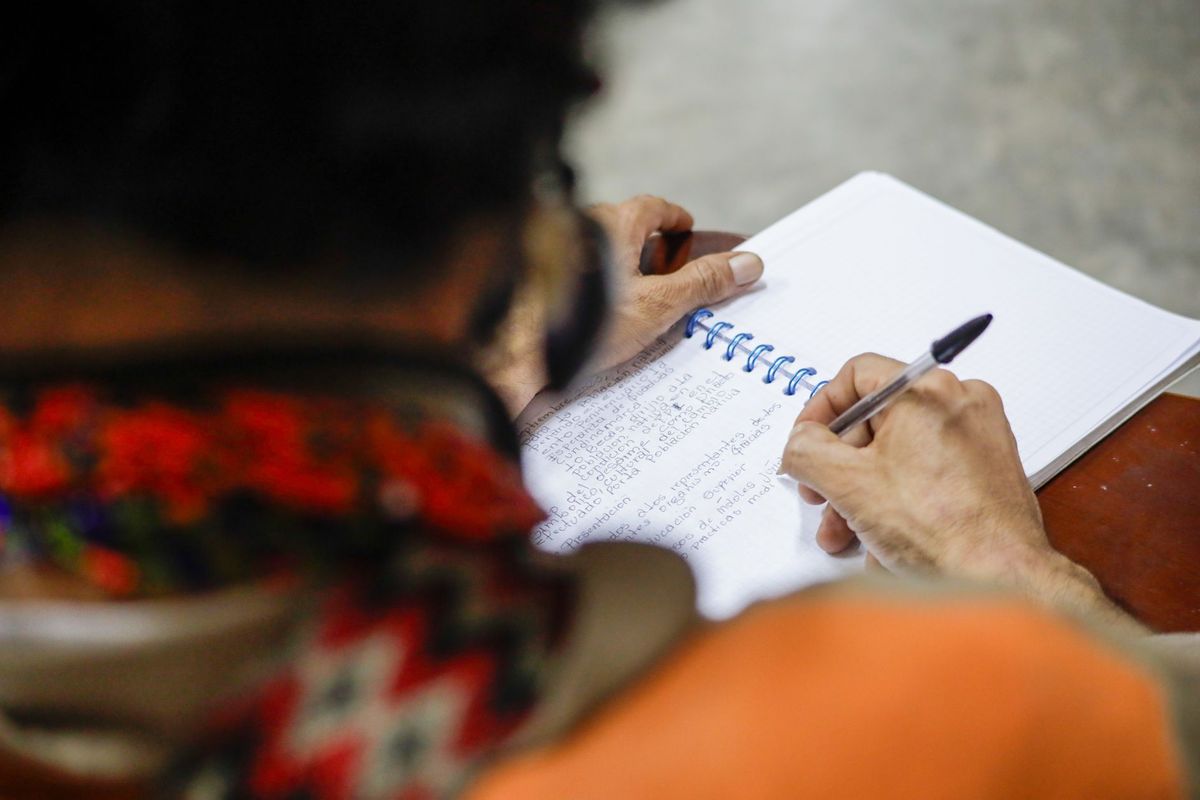
A small notebook opens instantly. No lock screen, no app update, no dying battery, no signal needed at 60 metres underground. You can write standing up with your thumb holding the page, and you can use it in the ten seconds between two stops. Handwriting also forces you to compress the thought, which is often why the note ends up being more useful than the rambling version you would have typed.
The weaknesses are real. Ink smudges when the bus lurches. Your handwriting on a bumpy Northern line carriage can be genuinely unreadable by lunchtime. Nothing is searchable, and a lost notebook takes everything with it — which is why a date at the top of every page and a name and phone number inside the cover are worth the thirty seconds.
Making paper work on the move
- Choose A6 or a slim A5 notebook; anything larger needs two hands and a table.
- Use a pen with a clip, not a loose lid. Retractable or capped-and-clipped both work; loose lids end up under the seat.
- Write in short bursts at stops and stations rather than during the swaying sections.
- Keep a running to-do list at the back and use the front pages for notes, so capture and action do not tangle.
- Add a date to every page. You will thank yourself when you flick back a fortnight later.
Digital: search, sync and no extra weight
An app wins on retrieval and on carry. You can search "deposit" or "Hannah" and find a note from March. Everything syncs between phone, tablet and work laptop, so the note you took on the bus is waiting when you sit down. Photographs of a whiteboard, a page from a book, or a poster in a station all sit alongside your text. Voice notes are genuinely useful on a crowded walk between platforms, and many apps will turn those recordings into text you can tidy later.
The friction is at the start, not the end. Unlocking a phone, finding the right app, choosing a notebook inside it, waiting for a sync — that is four seconds you may not have while changing trains. Notifications make it worse. A quick capture that begins with a glance at a message is not a quick capture at all.
Making an app commute-proof
- Put note capture on your lock screen or as a home-screen widget, and set the app to open a new blank note rather than the last one.
- Turn on offline notes before you travel, then let the app sync when you surface.
- Keep one inbox notebook for everything. Sorting into projects is a job for later, not for the Piccadilly line.
- Switch on aeroplane mode during the journey if you find yourself drifting into other apps.
- Charge your phone before you leave. A dead phone is a lost notebook with better manners.
The Tube problem, the bus problem and the train
Journey type matters more than personal preference. On a busy Tube with no signal, paper or an offline app are the only reliable options, and if you are standing, a notebook is easier than typing with one thumb. On a jolting bus, voice notes beat both — short, whispered, and cleaned up later. On a longer train journey with a table, a laptop or tablet is comfortable and efficient, and that is where digital note-taking shows its real advantage: you can type properly and file everything in one sitting.
On a short walk to the station, do neither. Use a voice memo. Nobody in a British street will find it strange.
A hybrid routine that survives real journeys
Most commuters end up with both, and that is fine as long as the two halves connect.
- Carry a small notebook and your phone. Capture on paper while you are moving.
- On the walk from the station, spend sixty seconds turning the page into digital notes — photograph it or dictate a summary.
- File those notes into one place the same day, not the same week.
- Before the notebook is full, check that nothing important is still only on paper.
- Review the digital collection once a week and delete what has stopped being useful.
- If you prefer typing first, reverse it: capture in the app, then copy the day's three priorities into the notebook each evening.
Choosing for your own journey
- Standing on a ten-minute bus: paper, or a voice note.
- Forty minutes on a train with a table: either; digital if you type quickly.
- Deep Tube, no signal, no seat: paper, or an app set to offline.
- Lots of switching between devices: digital, with a weekly paper review.
- Prone to losing things: digital, with a backup enabled.
- Easily pulled into your phone: paper, and leave the phone in your bag.
Test it for one week before you commit
Pick one method, use it for five commutes, and judge it on what you actually captured rather than how good it felt. If half your notes never made it out of the carriage, the method is wrong for that journey, not for you. The routine that lasts is usually dull: one place to capture, a tidy-up within a day, and a short review at the end of the week. Choose whichever of the two you will genuinely open tomorrow morning at 07:42.
Photo: Pixabay / Pexels

You Might Also Like
Time blocking turns scattered notes into clear next steps. Learn how to schedule short, repeatable note-processing sessions that fit around real work.
A practical, step-by-step method for backing up, archiving and safely deleting old notes, so your system stays searchable without losing anything you might need again.